What Is Software Project Management: Complete Guide for Modern IT Teams


(If you prefer video content, please watch the concise video summary of this article below)
Key Facts
- Software project management transforms technical processes into an organized delivery mechanism where strategy, scope, engineering efforts, quality control, risk factors, software release, and communication are tied together.
- The role of project management in software development becomes even more important as a result of AI, since, while faster execution may yield more results, it requires ownership, a unified context, effective testing, and efficient workflows.
- Project management methodology varies from one type to another: the success of Waterfall, Agile, Scrum, Kanban, and Lean depends on specific circumstances and conditions.
- Planning serves as the basis for successful outcomes because proper scope definition, requirement management, scheduling, budgeting, risk management, quality assurance, and communication prevent delays and extra work.
- Successful project management relies on visibility and organization: Correct tools, documentation, metrics, collaboration, and release management are the key components.
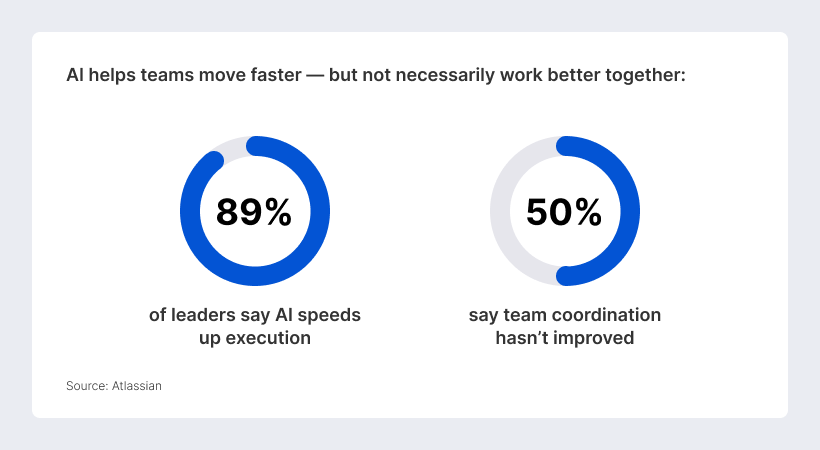
Software project management has become more — not less — important in the AI era. In April 2026, Atlassian reported that 89% of executives said AI had made execution faster, yet half said cross-team coordination had not improved.
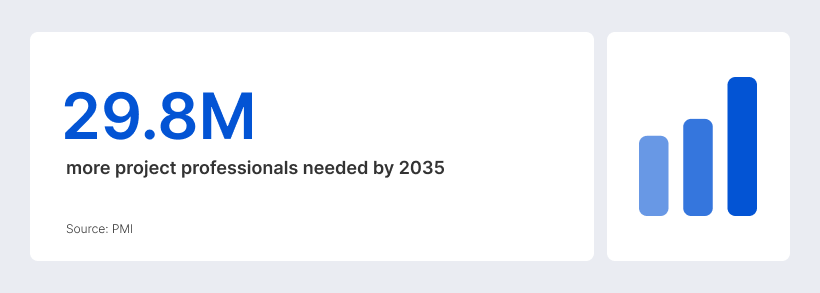
At the talent level, PMI projects that up to 29.8 million additional project professionals will be needed by 2035. The takeaway is simple: faster tools do not replace disciplined management; they raise the cost of weak planning, vague ownership, and poor communication.
What Is Software Project Management?
A definition of software project management is straightforward: it is the discipline that turns software work into a controlled delivery process, aligning scope, timelines, costs, quality expectations, risks, and team responsibilities around one defined outcome.
Put simply, project management in software engineering gives technical work a business frame: it defines what should be built, why it matters, how progress will be controlled, and how the final result will be accepted.
Why software project management is important
The value of software project management is not bureaucracy. Its value is reducing avoidable failure while improving delivery efficiency across planning, development, testing, and release activities. It creates clarity on what is being built, who owns which decisions, which risks matter now, what “done” means, and how progress will be measured.
It also protects teams from the modern speed trap. DORA’s April 2026 AI research found that while generative AI improves individual productivity and well-being, a 25% increase in AI adoption was associated with a 1.5% decrease in delivery throughput and a 7.2% decrease in delivery stability when teams did not reinforce fundamentals such as fast reviews and automated testing. Strong project management is what keeps speed from turning into rework.
Achieve digital transformation with software engineering services delivered by SaM Solutions’ seasoned engineers.
Software project management vs. software development management
These two disciplines overlap, but they are not the same. A practical definition of software development management is the coordination of engineering people, technical processes, architecture decisions, quality standards, and delivery practices that shape how software is built. Software project management, by contrast, is primarily concerned with delivering an initiative successfully.
| Aspect | Software project management | Software development management |
|---|---|---|
| Primary focus | Scope, schedule, cost, risk, dependencies, stakeholder alignment, and delivery | Engineering process, technical quality, architecture, team health, platform, and metric optimization |
| Main question | Are we delivering the initiative in a predictable, controlled way? | Are we building the software in a technically sound, sustainable way? |
| Typical owner | Project manager, delivery lead, scrum master in agile environments | Engineering manager, development manager, technical lead |
| Core artifacts | Project brief, roadmap, work breakdown, risk log, status reports, and communication plan | Architecture decisions, engineering standards, pipelines, quality gates, technical metrics |
| Success signals | Visibility, on-time delivery, budget discipline, accepted scope, stakeholder confidence | Code quality, release reliability, maintainability, engineering effectiveness, and team capability |
Key Phases of Software Project Management
Once the team has answered the question “What is software project management?”, the next step is to turn that understanding into a practical delivery plan that consists of several phases. Used well, these phases turn software project management in software engineering into a practical rhythm for decisions, progress reviews, and quality checks.
Initiation addresses the “Why this project?” question before the team dives into the strategy. During this phase, the leadership creates the business rationale, the anticipated value, the main deliverables, the success criteria, and even the approximate limits of the project. A proper initiation process also determines the project sponsor and scopes the project correctly with the help of relevant stakeholders to avoid focusing on the wrong problem.
Planning transforms intent into an operational design. It is at this stage that the team determines the project scope, divides the task into smaller parts, estimates the effort required, develops the timeline, allocates responsibilities to different people, recognizes potential risks, specifies the desired quality standards, and determines the change management process.
Execution is when the plan becomes real. Teams create, construct, test, evaluate, integrate, and prepare for deployment while project managers resolve issues and maintain alignment with the project goal. In an agile setting, execution occurs in rapid feedback cycles; in a predictive setting, execution occurs in sequence through phase gate reviews. Regardless, the idea remains the same: produce usable increments without forgetting about the predetermined goal.
Monitoring and controlling is the process of maintaining execution discipline. The project manager monitors project progress, budget, quality, risk exposure, dependencies, and authorized change requests in relation to the project plan, intervening early on minor problems that could turn into significant defects or schedule delays.
Closure formalizes acceptance, hands off documentation, passes on documentation and support responsibilities, documents the lessons learned, and verifies that the project has achieved its goals. While it might seem simple to overlook this stage, it is critical. Moreover, release-readiness reviews could help in uncovering any lack of documentation, support elements, or deployment issues in advance.
Software Project Management Methodologies with Examples
In this section, we look at the main software project management methodologies teams use to plan, organize, and deliver work.


Software Project Management Planning: Key Steps
In software development project management, a good plan is not a pile of documents. It is a shared decision system. The aim is to reduce uncertainty before it becomes costly, while keeping enough flexibility to adapt as the project evolves. The following steps are the core of that discipline.
Project scope outlines everything that the project will and won’t do. This should include business goals, deliverables, constraints, exclusions, assumptions, and success criteria. Without a scope definition, project teams tend to treat work as progress without understanding what the scope of the work actually is.
Requirements are the foundation of the whole plan. It is the practice of documenting, tracing, analyzing, prioritizing, and agreeing on requirements throughout the product lifecycle, which helps teams detect errors early and reduce cost and risk. In plain language, vague requirements create expensive surprises later.
A work breakdown structure is the process of breaking down the whole project into smaller work packages that can be estimated, allocated, and managed. It is an essential element of software development because it allows one to break the abstract ideas down to tangible deliverables and tasks. If teams neglect this step, they risk encountering hidden complexity long after the deadlines have been announced publicly.
A schedule is not simply a series of deadlines; rather, it shows the order in which tasks must be performed and dependencies between these tasks. This helps the team see what should be done when. Modern scheduling tools make it easy to create visual representations of timelines and dependencies.
Estimation should cover people, skills, tooling, environments, vendor costs, contingency, and management overhead — not just development hours. Resource management is among the core project manager responsibilities, and practical budgeting remains one of the strongest predictors of whether a project remains credible when change arrives.
Risk management should identify technical, delivery, security, integration, business, and operational risks at an early stage of development. Risk management is a key to preventing project delay and failure. When it comes to software projects, risk mitigation typically entails architectural spikes, dependency analysis, rollbacks, security testing, and approvals for releases.
The Scrum guide states that developers have the responsibility of ensuring quality through a Definition of Done, while the 2026 AI research by DORA emphasizes the significance of automated testing and high-quality feedback loops in the case of increased code volume. As such, QA planning should involve testing strategies, acceptance criteria, code reviews, regressions, release testing, and production monitoring.
Communication strategies provide information about who requires what information, how, and when. In this regard, communication planning plays an essential role in facilitating collaboration across remote teams, according to the Project Management Institute. Effective communication planning ensures that project status, decisions, risks, and changes do not become tribal knowledge.
The review process is meant to assess the feasibility, thoroughness, and agreement on the plan before its implementation. It should check whether the assumptions, decision authority, risk, escalation processes, etc., remain relevant. The sponsors will have an important task of confirming the scope and the objectives of the project, thus focusing it on solving the business issue.
Types of Software Projects
Not all software projects fail — or succeed — for the same reasons. The management model should reflect the type of project, because the planning horizon, risk profile, and stakeholder map can look very different between a greenfield product and a large enterprise integration.
Development projects
Development projects usually center on creating or modernizing a software product or feature set: web applications, mobile apps, cloud services, APIs, AI-enabled features, or MVPs. The main challenge is uncertainty — teams are often discovering user needs, validating assumptions, and evolving design decisions while the work is in progress. That makes short feedback loops, clear ownership, and high-quality backlog management especially important.
Enterprise and integration projects
Enterprise and integration projects are often less about building a single product from scratch and more about connecting ecosystems: ERP or CRM integrations, legacy modernization, cloud migration, data analytics, compliance-heavy platforms, or multi-system rollouts. Here, the complexity usually comes from dependencies, approvals, technical interfaces, and operational readiness rather than only code creation. These projects demand stronger change control, configuration discipline, and release planning.
Key Roles in Software Project Management
Clear roles reduce friction. The most resilient software teams separate decision ownership from contribution: one role may define priorities, another may coordinate execution, while the team itself remains accountable for building working software. That separation improves speed because it reduces ambiguity.


Types of Management in Software Project Management
IT software project management is really a bundle of specialized management disciplines operating at the same time. On a mature team, these are not side activities; they are part of the framework that maintains reliability as complexity grows.


Tools for Effective Software Project Management
The right software project management tools help teams organize work, share information, coordinate decisions, and keep projects moving from initial planning to release. The table below summarizes the main tools and their typical use cases.
| Tool | Best used for | How it supports software project management |
|---|---|---|
| Jira | Agile planning and issue tracking | Supports backlogs, sprints, bugs, workflows, dashboards, and release planning. |
| Confluence | Documentation and knowledge sharing | Keeps requirements, decisions, meeting notes, and release documentation in one place. |
| Trello | Lightweight visual planning | Uses simple boards and cards for task tracking, priorities, and basic workflows. |
| Asana | Cross-functional coordination | Helps manage tasks, approvals, dependencies, calendars, and project timelines. |
| Monday.com | Flexible work management | Supports custom workflows, dashboards, roadmaps, automations, and team visibility. |
| ClickUp | All-in-one project workspace | Combines tasks, docs, dashboards, goals, time tracking, and workflow automation. |
| Microsoft Project | Complex scheduling | Helps manage dependencies, milestones, resources, budgets, and the full project timeline. |
| Slack | Fast team communication | Supports project channels, quick updates, external collaboration, and lightweight workflow automations. |
| GitHub | Developer collaboration | Connects issues, pull requests, code reviews, branches, and delivery workflows. |
| GitLab | DevSecOps delivery | Combines source control, CI/CD, security checks, release management, and monitoring. |
| Azure DevOps | Microsoft-based delivery | Provides boards, repos, pipelines, test plans, artifacts, and traceability. |
| Basecamp | Simple team collaboration | Brings together to-dos, schedules, files, messages, and client communication. |
| Wrike | Enterprise work management | Supports approvals, dashboards, workload planning, reporting, and configurable workflows. |
| Smartsheet | Portfolio and project tracking | Offers spreadsheet-style planning with milestones, dependencies, dashboards, and reporting. |
| Notion | Docs and lightweight project tracking | Combines wikis, project pages, task databases, notes, and simple team workflows. |
Best Practices for Successful Software Project Management
Successful software project management is built on practical habits that help teams stay aligned, reduce uncertainty, control quality, and maintain strong delivery performance even when requirements, priorities, or technologies change:
- Choose the right delivery method: Do not follow Agile, Waterfall, or hybrid models by habit. Select the approach based on project uncertainty, compliance needs, dependencies, and team maturity.
- Create one source of truth: Keep requirements, decisions, risks, tasks, and documentation in clear shared systems. This reduces confusion, duplicated work, and unnecessary meetings.
- Measure flow and quality together: Track speed, defects, review time, testing results, and release stability. Strong delivery performance comes from balancing output with reliability.
- Use AI with structure: AI can support planning, documentation, summaries, and coordination, but it needs clear policies, human judgment, and reliable project context to create real value.
Challenges in Software Project Management and How to Overcome Them
Even well-planned software projects can run into trouble when complexity grows, priorities shift, or teams lose shared context. The table below summarizes the most common challenges and practical ways to address them.
| Challenge | Why it creates problems | Practical solution |
| Fuzzy requirements | Teams may build features that do not match business needs or user expectations. | Strengthen discovery, document requirements clearly, prioritize the backlog, and refine requirements throughout the project. |
| Scope creep | Small informal changes can gradually expand the project beyond the agreed timeline, budget, or capacity. | Define change-control rules early and make every new request visible, reviewed, and approved before it enters the plan. |
| Weak dependency management | Delays appear late when teams overlook dependencies between systems, APIs, vendors, approvals, or other teams. | Track dependencies in one visible work system and assign clear owners for each critical dependency. |
| Poor cross-functional communication | Product, engineering, QA, security, operations, and business teams may work from different assumptions. | Use one source of truth for decisions, requirements, risks, release notes, and technical documentation. |
| Release instability | Faster development can create more output than review, testing, and deployment processes can safely handle. | Set explicit release criteria and strengthen automated testing, continuous integration, code reviews, and rollback planning. |
| Activity mistaken for progress | Many tickets, meetings, and drafts can make a project look active even when teams are not moving toward the same goal. | Measure flow and quality together, reduce batch size, keep priorities clear, and make key decisions easy to trace. |
Benefits of Software Project Management in SaM Solutions
SaM Solutions is an international provider of IT services and software solutions with more than 30 years of experience, 1000+ completed projects, 800+ IT experts, and a presence across Europe and the U.S. In that kind of operating model, project management is what turns broad delivery capacity into predictable outcomes, supporting scalability without losing control over scope, quality, communication, or release discipline.
This approach connects multiple teams, technologies, and delivery stages into one coordinated flow, giving clients clear practical benefits:
- Predictable delivery: Complex software initiatives become easier to plan, track, and adjust before risks turn into delays.
- Better transparency: Clients receive clearer priorities, visible progress, and a better understanding of key decisions and dependencies.
- End-to-end coordination: Different specialists work within one aligned process instead of handing tasks over in disconnected fragments.
- Stronger quality control: Requirements, testing, reviews, and release readiness are managed as part of the project from the beginning.
- Business-value focus: Delivery remains connected to measurable business goals, not just technical output.
Develop your custom software with SaM Solutions’ engineers, skilled in the latest tech and well-versed in a wide range of industries.
Conclusion
Project management in software engineering is no longer a support function sitting beside development. It is the discipline that makes complex software work governable. It gives teams a way to connect scope, requirements, people, risk, quality, and release decisions into one coherent operating model.
The strongest teams are not the ones moving fastest as individuals. They are the ones that combine speed with shared context, strong planning, visible ownership, small feedback loops, and reliable release practices.
FAQ
What certifications are recommended for a software project manager?
PMP is the most established certification for broad project leadership. For agile environments, PMI-ACP, Scrum Alliance, and Scrum.org certifications are useful. PMI-RMP fits risk-heavy roles, while PRINCE2 and PRINCE2 Agile remain relevant in governance-driven organizations.
How do AI tools influence software project management processes?
What industries rely most on software project management?
How does remote work impact software project management?
What is the difference between technical and non-technical project managers?